


A Dubai villa renovation should improve the room that struggles at four in the afternoon. Photographs cannot prove that. A west-facing family room may feel calm in winter, then overheat throughout summer. That contrast is useful evidence because it shows where design decisions should begin.
The first priorities are usually heat gain, air leakage, shading and cooling demand. Finishes still matter, but they should follow those decisions. Otherwise, an expensive interior can inherit the same hot spots and draughts. It may also repeat older maintenance problems. The principle applies across Dubai home renovation projects, from refurbishment to targeted remodelling.
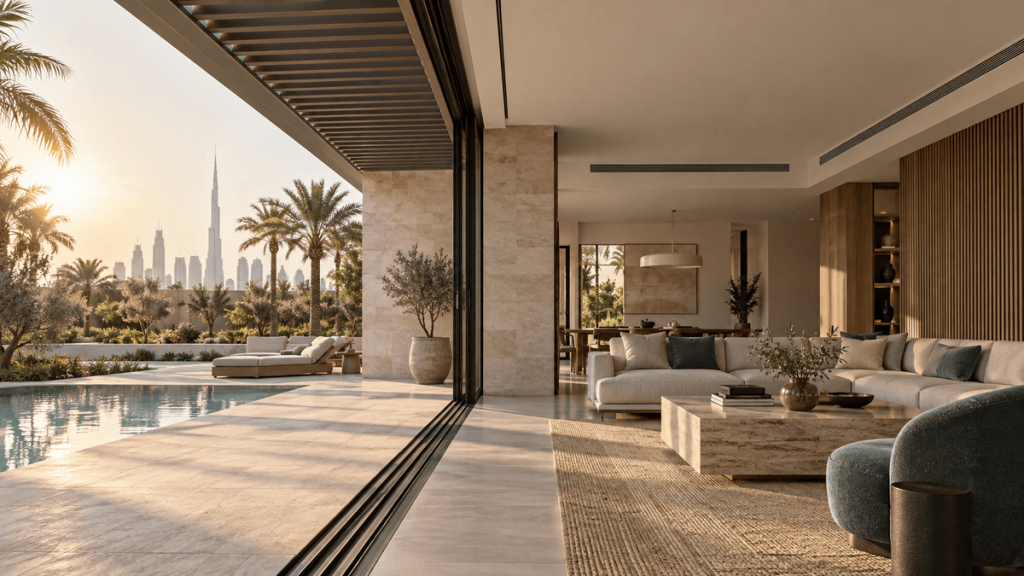
Where a Dubai villa renovation should begin
Existing villas rarely behave exactly as their drawings suggest. Later extensions, replacement windows or unevenly aged waterproofing can change their behaviour. Occupants often know the symptoms better than anyone. Ask which rooms feel warm, humid, noisy or dusty, then record when.
A measured survey should then test those observations against the building. Record roof build-ups, external walls, glazing, door seals, drainage falls and air conditioning zones. Look for staining, failed sealant, condensation and repeated repairs. Utility bills can also reveal seasonal patterns that a single site visit will miss.
An architectural and design assessment can connect those observations to the building. It separates a design problem from an equipment problem. A room that overheats every afternoon may not need a larger cooling unit. External shade or repaired air sealing may address the cause more effectively.
The envelope sets the cooling load
The roof, external walls, windows, exposed floors and doors form the building envelope. In Dubai, they decide how much heat the air conditioning system must remove. In a Dubai villa renovation, envelope improvements can reduce demand before equipment replacement.
Dubai Municipality’s Al Sa’fat system puts envelope performance at the centre of design. Its requirements cover thermal transmittance, glazing, air leakage and shading. Thermal transmittance is commonly expressed as a U-value. A lower U-value means less heat passes through the element.
A Dubai villa renovation may not share a new villa’s compliance scope. The building physics remains relevant. Roof insulation and waterproofing need one coordinated detail. Window frames deserve the same attention as glass. A villa extension must connect carefully with the existing structure. Insulation, air sealing and waterproofing should remain continuous.
Use shade before asking glass to do everything
More glass can bring daylight and views, but orientation changes the result. West-facing windows receive strong, low-angle sun late in the day. This often coincides with higher occupancy in family and living areas.
External shade stops direct sun before it reaches the glass. Deep reveals, canopies, pergolas and screens can all work. Their geometry must follow the actual sun path. Planting can help where roots, irrigation and maintenance will not create another problem.
High-performance glazing still needs careful selection. Solar control, visible light, colour and reflectivity affect comfort and appearance together. Review a full-size sample at the property. A small catalogue swatch cannot show the complete effect. Glass looks different beside the façade at midday and sunset.
Size cooling for the renovated plan
The HVAC system in a Dubai villa renovation must reflect the final plan. Removing walls, enclosing a terrace or adding a bedroom changes cooling loads and air distribution. The old equipment schedule should not be carried forward without calculation.
An oversized system may cool a room quickly, then cycle too often. That can weaken humidity control and create uneven temperatures. An undersized system will struggle during peak conditions. A room-by-room heat-load calculation gives the engineer a reliable basis. It guides equipment, ductwork, grilles and control zones.
Zoning is useful when occupancy changes through the day. Guest rooms and formal spaces may follow different schedules. Bedrooms and family areas often need longer cooling periods. Smart controls can support that strategy but cannot correct poor ducts or envelope leaks. DEWA’s cooling guidance recommends window shading, effective seals and suitable thermostat control. It also advises regular filter cleaning.
Keep construction dust out of the air system
During a Dubai villa renovation, dust management becomes a technical requirement. Demolition dust can enter return-air paths and settle inside ducts. Paints, adhesives and sealants may affect indoor air during the works and shortly after completion.
The second edition of Al Sa’fat sets specific measures for construction and renovation. HVAC openings and ductwork should be protected from contamination. Operating systems need temporary MERV 8 filtration during the work. Install new permanent filters before occupancy.
On site, separate clean and dirty zones. Seal active work areas and plan a safe debris route. The handover should include cleaned grilles, fresh filters and a check of concealed spaces. These details become harder to correct once ceilings and joinery are closed.
Choose materials after seeing them outdoors
Material choices in a Dubai villa renovation must withstand ultraviolet light, heat and dust. Coastal villas may also face salt-laden air. Pool decks add water and cleaning chemicals to the mix. Product names alone do not show how a finish will behave under those conditions.
Specifications should cover the substrate, primer, adhesive, fixing, sealant and movement joint. A premium finish can still fail on the wrong base. Dark surfaces may become uncomfortable to touch, while very pale ones can produce glare. Place full-size samples outside and review them when direct sun reaches the surface.
Interior materials need the same discipline. Stone, timber veneer, large-format tiles and painted joinery respond differently to moisture and temperature. Old and new work move differently. Their junctions need enough tolerance to prevent cracks or gaps.
Make maintenance part of the layout
A Dubai villa renovation should preserve practical access to every service component. Routine maintenance should not require dismantling a ceiling or damaging bespoke cabinetry. Filters, isolation valves, pumps, control panels and drainage points need practical access from the start.
Service routes should be drawn before ceilings and cabinetry are approved. This matters around concealed air conditioning units, bathrooms and kitchens. It also applies to irrigation controls and pool equipment. External drains should remain accessible after paving and planting are complete.
The handover file should contain approved drawings, product data, warranties, control settings and maintenance intervals. It should also identify specialist cleaning requirements. Good records simplify future maintenance. They also reduce uncertainty during the next alteration.
Plan an occupied renovation around daily life
An occupied Dubai villa renovation needs a programme built around temporary living conditions. Noise, dust, security, cooling and water shutdowns affect the order of work. The programme should show which services stay live and when temporary alternatives are needed.
Long-lead products should be released against approved dimensions. Imported stone, bespoke glazing and fitted joinery are costly to remake. Verify site conditions before release. Mock-ups can resolve difficult junctions before the same detail is repeated across several rooms.
The programme should also preserve time for testing and commissioning. Design approval comes before procurement. Hidden conditions should be exposed before final dimensions are issued. Handover is too late to begin balancing air systems or checking drainage falls.
A practical check before design approval
- Identify the rooms that are uncomfortable and the time each problem occurs
- Record where direct sun reaches glass walls and outdoor seating
- Compare the current villa with its approved drawings
- Recalculate cooling loads after every material layout or area change
- Test external finishes under real sun before approval
- Confirm access to every major service component
- Define temporary services if the villa will remain occupied
Judge the result after the first summer
Comfort is the most useful measure of a renovation. A Dubai villa renovation succeeds when architecture, engineering and maintenance share evidence. The villa then feels more consistent through the year. Its finishes also have a better chance of ageing well.